History of Present Illness
Patient is an adult male with no known medical history who presented after suddenly dropping to the floor without warning. Initial neuro exam and vitals were reported as normal, but he subsequently developed a continuous generalized tonic-clonic seizure while in the waiting room chair. Total seizure time exceeded 4-5 minutes, qualifying as status epilepticus.

Emergency Department Course
Triage & Initial Resuscitation
Patient actively seizing for approximately 4 minutes.
+1
Triage & Initial Resuscitation
Patient actively seizing for approximately 4 minutes.
Medical Decision Making
Patient is in status epilepticus. Immediate priority is to break the seizure to prevent hypoxic brain injury and hemodynamic collapse. Benzodiazepines are the first-line abortive therapy.
Diagnostics & Findings
- CBC
- CMP
- Urine Toxicology (via straight cath)
Findings:
- Hypoxia due to inadequate ventilation during tonic-clonic phase.
Interventions
- Lorazepam 4mg IV pushed (Total of 8mg given rapidly)
- 5L Oxygen via face mask
⮑ Outcome & Reassessment
Patient continues to seize despite receiving 8mg of IV Lorazepam. SpO2 remains in the low 90s.
Clinical Media

Medical Conflict & Escalation of Therapy
Refractory status epilepticus despite max standard dosing of Lorazepam.
Medical Conflict & Escalation of Therapy
Refractory status epilepticus despite max standard dosing of Lorazepam.
Medical Decision Making
Dr. Santos correctly advocates moving to a second-line antiepileptic drug (Levetiracetam/Keppra) due to the high risk of respiratory depression from stacking benzodiazepines. Dr. Langdon asserts seniority and pushes for an additional 2mg of Lorazepam, accepting the risk of needing to intubate the patient.
Diagnostics & Findings
Findings:
- Patient remains in active seizure > 5 minutes.
Interventions
- Additional 2mg Lorazepam IV (Total 10mg IV)
- Intubation tray prepped at bedside
- Respiratory therapy paged
⮑ Outcome & Reassessment
Shortly after the additional 2mg push, seizure activity breaks.
Post-Ictal Stabilization
Cessation of motor seizure activity.
Post-Ictal Stabilization
Cessation of motor seizure activity.
Medical Decision Making
With the seizure broken and respiratory drive intact, the patient requires a long-acting antiepileptic to prevent recurrence, supportive care, and advanced imaging to rule out structural causes.
Diagnostics & Findings
- CT Head ordered
Findings:
- Spontaneous breathing recovered, good tidal volume, no immediate need for intubation.
Interventions
- Levetiracetam (Keppra) IV loading dose
- Seizure precautions instituted (blankets/pads on bed rails)
⮑ Outcome & Reassessment
Patient is stabilizing post-ictally. Breathing spontaneously with resolving hypoxia.
Status Update
Follow-up post-seizure cessation.
Status Update
Follow-up post-seizure cessation.
Medical Decision Making
Patient's seizure activity has ceased and he is resting post-ictally. The immediate life threat has passed, but the underlying etiology must be identified via the pending head CT.
Diagnostics & Findings
- CT Head (Pending Results)
Findings:
- Patient is awake, alert, and resting in bed. No recurrent seizure activity.
Interventions
- Continued observation
⮑ Outcome & Reassessment
Patient has recovered from the post-ictal state and is sleeping comfortably.
Imaging Review & Diagnosis
Head CT results are finalized and ready for review.
Imaging Review & Diagnosis
Head CT results are finalized and ready for review.
Medical Decision Making
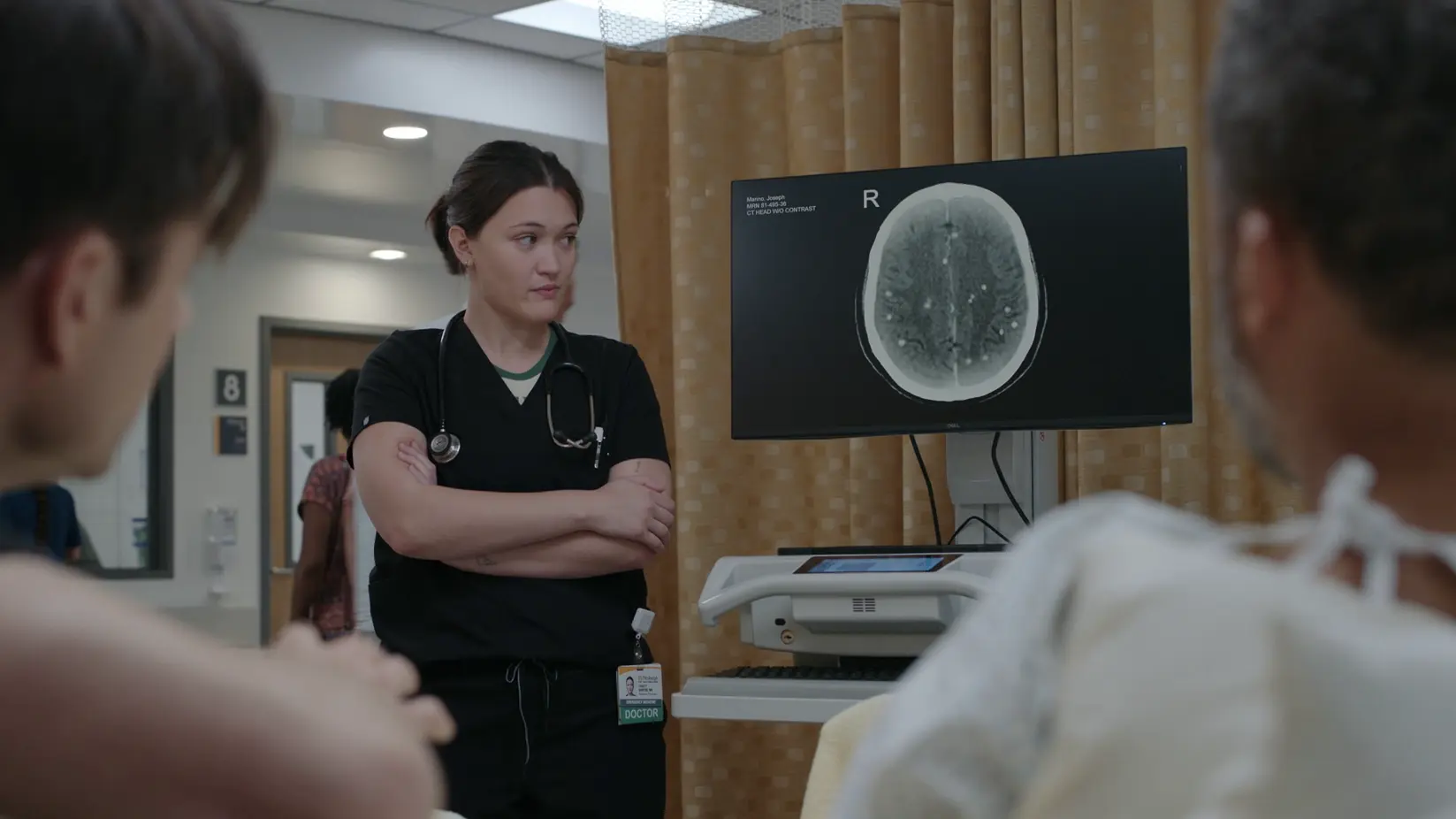
The CT scan reveals calcified cysts in the brain parenchyma, which is the hallmark of neurocysticercosis. Because the cysts are calcified, the Taenia solium larvae are dead (inactive disease). However, this calcified scar tissue serves as a highly epileptogenic nidus, explaining the patient's new-onset status epilepticus. No active anti-parasitic treatment is needed, only long-term antiepileptic management.
Diagnostics & Findings
- CT Head (Reviewed)
Findings:
- Small, calcified cysts in the brain tissue, indicating inactive neurocysticercosis.
Interventions
⮑ Outcome & Reassessment
Diagnosis confirmed.
Bedside Patient Education
Delivering the diagnosis of a parasitic brain infection to the patient.
+1
Bedside Patient Education
Delivering the diagnosis of a parasitic brain infection to the patient.
Medical Decision Making
Communicating a diagnosis involving 'brain worms' requires careful phrasing to prevent panic. It must be clearly explained that the parasite is already dead, the brain is not actively being destroyed, and that the patient will recover with simple symptom (seizure) management.
Diagnostics & Findings
Interventions
- Patient counseling and reassurance
⮑ Outcome & Reassessment
Patient is initially horrified by the idea of worms in his head but is reassured after learning they are dead, calcified, and pose no progressive threat.
Clinical Media
Diagnoses & Disposition
Evolving Diagnoses
- [S01E05]Status Epilepticus
- [S01E05]Hypoxia secondary to seizure
- [S01E06]Neurocysticercosis (Inactive/Calcified)
Current Disposition
Diagnosed with inactive neurocysticercosis as the etiology of his status epilepticus after CT Head review. The patient is awake, alert, and stabilized post-ictally, educated on his condition, and likely awaiting discharge with neurology follow-up and maintenance anti-epileptic therapy.
Casebook Analysis
Episode Context
This case highlights the traditional conflict between an evidence-based, textbook-oriented intern (Santos) and a 'gut-instinct', aggressive senior resident (Langdon). It also introduces a systemic hospital sub-plot regarding compromised medical supplies, validating the intern's initial struggle and removing the blame from her clinical execution. In episode 6, the diagnostic resolution of neurocysticercosis tests Dr. Langdon's bedside manner as he translates a highly disturbing parasitic diagnosis into reassuring clinical reality for the patient.
Attending's Review
Medical Accuracy
The definition of Status Epilepticus given by Santos (>5 minutes of seizure or two seizures without full recovery) is perfectly accurate according to modern Neurocritical Care guidelines. However, Dr. Langdon's decision to push 10mg of Lorazepam is highly controversial. Standard dosing is 0.1 mg/kg (usually 4mg, max 8mg). Pushing past 8mg heavily risks respiratory arrest. In a real ED, Santos's recommendation to start a second-line agent like Keppra or Fosphenytoin while preparing to secure the airway is the gold-standard correct move. In episode 6, the depiction of neurocysticercosis is medically accurate. Calcified, dead cysts (inactive neurocysticercosis) are a leading cause of acquired epilepsy worldwide. Reassuring the patient that the larvae are dead and no active anti-parasitic therapy is needed aligns with standard of care.
Complications & Errors
- Over-administration of benzodiazepines (10mg Lorazepam) without immediately moving to a secondary AED, placing the patient at an unnecessarily high risk for iatrogenic respiratory failure.
- Use of a potentially thermally-degraded medication.
Clinical Pearls
Status Epilepticus is defined clinically as 5 or more minutes of continuous clinical seizure activity, OR two or more discrete seizures without full recovery of consciousness in between. According to the latest ILAE guidelines, (t1): the 5-minute mark represents the failure of physiological seizure-suppression mechanisms for generalized tonic-clonic seizures. (t2): the 30-minute mark is when long-term neuronal injury can start to occur if seizures continue past 30 minutes.
When securing a seizing patient in the field or a waiting area, prioritize preventing secondary trauma: clear the area of dangerous objects, cushion the head, do not actively restrain the patient's movements, and never place anything in their mouth. Once the seizure stops, place the patient in the lateral decubitus (recovery) position to protect the airway from aspiration.
According to AES/NCS guidelines, the algorithm for benzodiazepine escalation in Status Epilepticus involves an initial weight-based dose (e.g., IV Lorazepam 0.1 mg/kg up to 4 mg) which can be repeated once after 5-10 minutes. If the patient remains seizing after two adequate doses (reaching the typical 8 mg max for Lorazepam), providers must immediately escalate to a second-line non-benzodiazepine antiepileptic (e.g., Levetiracetam, Fosphenytoin, or Valproate). Continuing to 'stack' further doses of benzodiazepines offers diminishing returns for seizure cessation and exponentially increases the risk of respiratory arrest.
Benzodiazepine 'stacking' precipitously increases the risk of iatrogenic respiratory failure. Pathophysiologically, this occurs because profound GABA-A receptor agonism strongly inhibits the medullary respiratory centers, blunting the patient's hypercapnic drive and leading to hypoventilation and apnea. If aggressive sedative dosing is required to break a refractory seizure, providers must preemptively secure the airway via endotracheal intubation and provide mechanical ventilation until the suppressive effects wear off.
Neurocysticercosis, caused by the larval stage of the pork tapeworm (Taenia solium), is the most common parasitic disease of the nervous system and a leading cause of adult-onset epilepsy worldwide.
In patients with calcified (inactive) neurocysticercosis presenting with seizures, the standard of care is symptomatic management with anti-epileptic drugs (AEDs). Anti-parasitic therapy (such as albendazole) is not indicated because the parasites are already dead, and the calcified scar tissue is the epileptogenic focus.
Similar Cases from The Show

Bob Chazen
Blister Guy
Ginger Kitajima
Elderly Fall Victim

Travis Johnson
Post-Tonsillectomy Hemorrhage Kid
Related Specialties
Chart Navigation
Mr. Marino
C/OSudden collapse followed by continuous generalized seizures